

Table of Contents
- Introduction: Why Shopify Search Matters
- What Is Shopify’s Native Search?
- How Shopify Search Indexes Your Store
- How Shopify Search Ranks Results
- Types of Shopify Search Queries
- Shopify Search Filters, Sorting & UX
- Limitations of Shopify’s Default Search
- How to Improve Shopify Search Results
- Expertrec Smart Search Bar
- Shopify Native Search vs Expertrec
- When Should You Upgrade Shopify Search?
- Conclusion
Introduction: Why Shopify Search Matters
Search is by far one of the most impactful yet often completely unoptimized features for most Shopify stores. Most, however, head directly for the search bar when they land on your site. On-site search visitors convert exponentially more than normal browsers, and numerous ecommerce studies prove this again and again.
Search in Shopify is essential to help shoppers locate products quickly, eliminate friction, and push them further down the funnel to check out. When search does its job, it boosts conversion rates, average order value, and the user experience in general. When it fails, shoppers get aggravated, discover “no results found” and abandon.
If this is the case, and it naturally leads to an important question for store owners and ecommerce managers to answer, “How does Shopify search work, and why does it feel inaccurate (or limited) at times, especially as the catalogue is growing?
In this article we are going to discuss how Shopify native search works, how it indexes and ranks the result, most of the limitation merchant face and how you can even improve better search performance.
What Is Shopify’s Native Search?
Within all Shopify store-fronts, there is an option for native search by Shopify. Gives shoppers a keyword search bar, usually in the header or the navigation menu, to explore content throughout the store.
Shopify search can naturally find:
- Products
- Collections
- Pages (e.g.- About or Contact Pages)
- Blog posts
This search is fully embedded inside your Shopify store, allowing users to find your internal content in no time.
Please keep in mind that Shopify storefront search has nothing to do with Google or other external search engines.
How Shopify Search Indexes Your Store
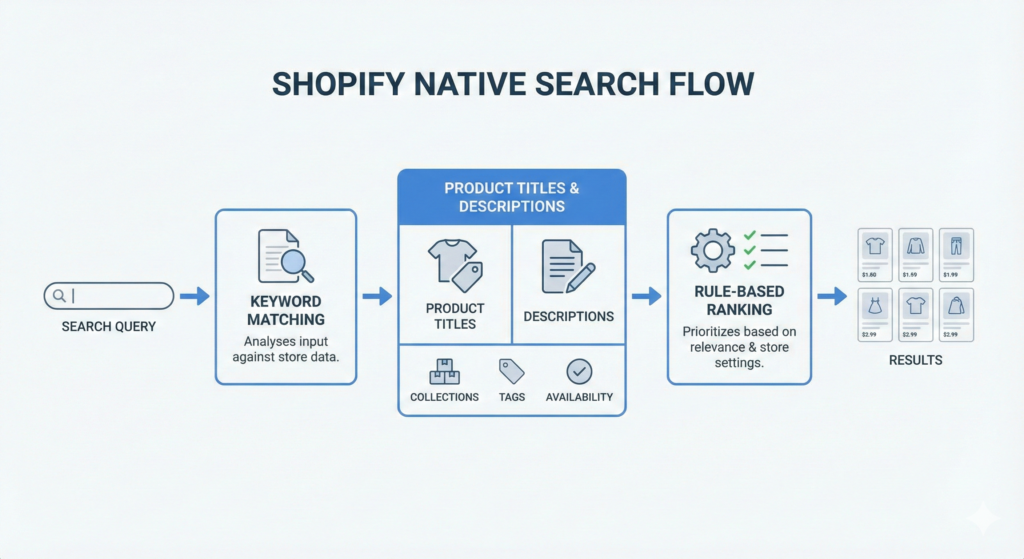
To know enough about how Shopify search works, you have to understand of the way it indexes your searches in the store.
Shopify primarily indexes:
- Product titles
- Product descriptions
- Variants, including SKUs and options
- Tags
- Product types and vendors
- Collections and product availability
Discoverability can be heavily impacted by the quality of your data.
How Shopify Search Ranks Results
Shopify search is a rule-based process rather than semantic or AI-driven.
- Keyword proximity
- Keywords in the product title
- Availability
- Collection association
- Basic engagement signals
This approach works for simple queries but fails with larger catalogs and intent-based discovery.
Types of Shopify Search Queries
- Exact match searches
- Partial match queries
- Phrase searches
Shopify struggles with misspellings, synonyms, plurals, and word variations.
Shopify Search Filters, Sorting & UX
Shopify offers basic filtering and sorting such as price, availability, and relevance.
Filtering helps usability but does not solve poor relevance.
Limitations of Shopify’s Default Search
- Limited ranking control
- Weak typo tolerance
- No semantic intent understanding
- Limited merchandising controls
- Shallow analytics
How to Improve Shopify Search Results
- Clear product titles
- Keyword-rich descriptions
- Consistent tagging
- Logical collections
These steps help, but only to a point.
Expertrec Smart Search Bar: A Smarter Shopify Search Solution
Expertrec Smart Search Bar augments Shopify native search with AI-powered and semantic search.
- Smart autocomplete
- Advanced typo & synonym handling
- Merchandising controls
- Deep search analytics
Discover the Expertrec Shopify app here:
https://apps.shopify.com/expertrec-search

AI-powered site search with instant autocomplete
Deliver lightning-fast search experiences with ExpertRec
ExpertRec helps you implement intelligent autocomplete, typo-tolerant search, personalized results, and scalable server-side search — all without complex infrastructure or heavy development effort.
Quick setup • No coding required • Works on any website
Shopify Native Search vs Expertrec
- Rule-based vs AI-based
- Literal vs semantic matching
- Limited vs advanced merchandising
- Basic vs deep analytics
When Should You Upgrade Shopify Search?
If you rely heavily on on-site search, see frequent “no results found”, or need better control and insight, upgrading makes sense.
Conclusion
Shopify native search works for basic needs, but as catalogs grow, limitations appear.
SEO and search optimization are revenue levers. Better product discovery creates better buying experiences.
For merchants ready to move beyond keyword matching, advanced search solutions like Expertrec are the natural next step.