
When someone types into your ecommerce search bar, they’re not casually browsing—they’re ready to buy. That moment of intent is the most powerful second in the entire shopping journey. Most ecommerce sites fail to handle this moment well. But they should know the statistics.
Most users begin with search
One of the most well-known facts in ecommerce is that lot of visitors go directly to search. If half your visitors start their journey by typing instead of browsing, it tells you two things:
This alone is a strong enough reason to put your search bar in a prominent place. A visible, clean, inviting search bar increases engagement. It sounds obvious, but many stores still miss it.
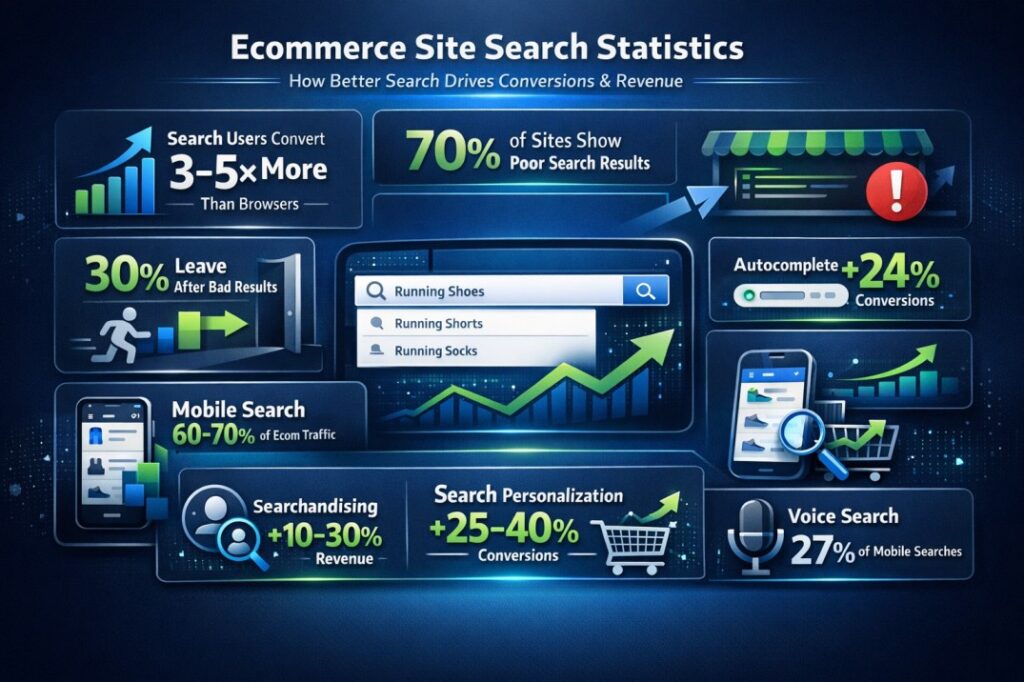
Search users convert 3–5 times more than normal browsers
This statistic is my personal favorite because it literally shows how powerful search can be. If you’re casually browsing a clothing site, you might stay for a few minutes and leave. But if you type “black running shoes size 9”, your intent is crystal clear. You’re not browsing. You’re ready to buy.
That’s why improving search is one of the easiest, most direct ways to increase sales without increasing traffic. You don’t need more visitors; you need visitors to find what they came for.
If your search results are bad, people leave within seconds
This is precisely the point where a lot of online retail companies lose a huge amount of money without even being aware of it. The latest studies report that:
It’s not that customers are impatient; it’s just that they are quite aware of the alternatives. If your website cannot display the item, they will just put the same keyword on Google and find it at a different place. The brand with the superior search experience takes the place.
70% of ecommerce sites still show poor or irrelevant results
This might be hard to believe, but it is the case. All the current search tools, plugins, AI systems, and search engines have not contributed to enhancing search accuracy on most online shopping sites which still have high inaccuracies. The problems that are frequently encountered are:
When customers are presented with irrelevant results, they immediately lose their confidence on the website.
Autocomplete helps speed up purchases
Modern-day ecommerce customers are no longer keen to type out lengthy product names. They have already adjusted themselves to the Google-style interface. Hence:
The Autocomplete feature is not only a time-saver, but also a necessity. The customers want to be presented with options even before they complete their typing. Thus, in essence, the Autocomplete functions as a subtle sales tool along with being a UX tool.
Zero results pages cost ecommerce stores millions
The “No results found” page is the silent conversion killer of the highest order.
Consider a scenario where a person is typing a product that is in stock, but your search cannot decode their spelling or language. They are shown with an empty screen. They pre assume it is not available and consequently, they exit the site.
Some companies manage to mitigate this by:
However, the most effective solution lies in correcting the search. A “No results” page should be the last resort, not the standard outcome.
Searchandising: The new age of smart selling
Another interesting statistic emerging from modern ecommerce is the rise of searchandising. It is, in fact, the combination of search outcomes and sales promotion activities. For example,
Brands that implement searchandising techniques are already experiencing:
All this indicates that search has moved from being a back-office operation to becoming an important marketing channel.
Mobile search matters more than ever
Nowadays, mobile search has over 60–70% of ecommerce traffic, thus becoming an enormous influencer. Mobile users tend to type slow but browse fast and are quick to leave. That is why their demands are quite high, including:
Mobile search that takes more than 2 seconds to open loses as much as 50% of its customers. Speed is the key factor on this matter.
Filters and sorting boost search efficiency
Using filters after searching increases the chance of the customer making a purchase by fourtimes. Not always people know precisely what they want; they only have a rough idea such as: black running shoes, less than ₹1500, size 8, male.
If your filters are getting collapsed, taking a long time to load, or not visible on mobile devices, that’s revenue slipping through the cracks.

AI-powered site search with instant autocomplete
Deliver lightning-fast search experiences with ExpertRec
ExpertRec helps you implement intelligent autocomplete, typo-tolerant search, personalized results, and scalable server-side search — all without complex infrastructure or heavy development effort.
Quick setup • No coding required • Works on any website
Personalized search increases conversions dramatically
Personalization used to be optional in ecommerce. Not anymore.
When websites show personalized search results based on:
The statistics show:
Shoppers don’t want generic search—they want relevant search.
Voice search is growing in ecommerce
With mobile usage on the rise, voice-based search is emerging as an important element of the ecommerce experience. While still not dominant, studies show:
Customers search like: “Show me men’s sports shoes size 9”,” Find laptop bags under 1000 rupees”. If your search engine doesn’t understand natural language, you’re missing out on future-ready opportunities.
Conclusion
The statistics make one thing crystal clear that your ecommerce search experience directly decides your revenue, repeat visits, and customer satisfaction. A good site search can boost conversions, reduce exit rates, increase product discovery, improve customer loyalty, raise average order value, support your marketing strategy.
But a poor site search can kill sales—even when your products are excellent. Making your ecommerce search smarter, faster, and more personalized is no longer an optional anymore -It’s essential.