

Table of Contents
- Shopify Search: The Native Starting Point
- Algolia: API-First Search Infrastructure
- ExpertRec: A Dedicated Search Layer for Shopify
- The Technical Difference: Retrieval and Ranking
- Why SKU Search Matters
- Search Analytics: From Queries to Revenue
- INR Revenue Example
- Which Search Architecture Fits Your Store?
The native search feature might work fine in a Shopify store with a few hundred products. However, when the product catalog has grown to thousands of products and variants, search is no longer just about obtaining a product but more about ranking products and discovering them.
When looking for “black running shoes under ₹5,000,” the customer expects the search engine to not simply return the results that fit the keywords; instead, it is assumed that the search engine understands product type, color, and value.
This is why when looking for search options, Shopify merchants often choose between Algolia, Shopify Search, and ExpertRec.
Search is not merely an abstract concept; it is a service that can be evaluated through its commercial ability. Algolia speaks of e-commerce shoppers utilizing search, stating that they spend 2.6 times more than those not using it, while its findings show that advanced search yields much higher conversion rates than basic search.
Algolia vs Shopify Search vs ExpertRec
Shopify Search: The Native Starting Point
 Shopify Search is not limited to keyword searching.
It also includes features like relevance-based search, pagination, filtering of products, and partial matching features with the use of the Storefront API.
Other search features like product title, vendor, and barcode are also available. Predictive search generates suggestions during the word entry stage and makes it very easy for consumers to discover the products they want.
Shopify Search and Discovery has also started to provide analytics reports on clicks, purchases, number of search queries, number of unsuccessful search queries, and number of search queries that didn’t record clicks.
 With a small catalog, these features will be more than enough. Problems arise when the search process involves more complex ranking mechanisms or query interpretations.
Algolia: API-First Search Infrastructure
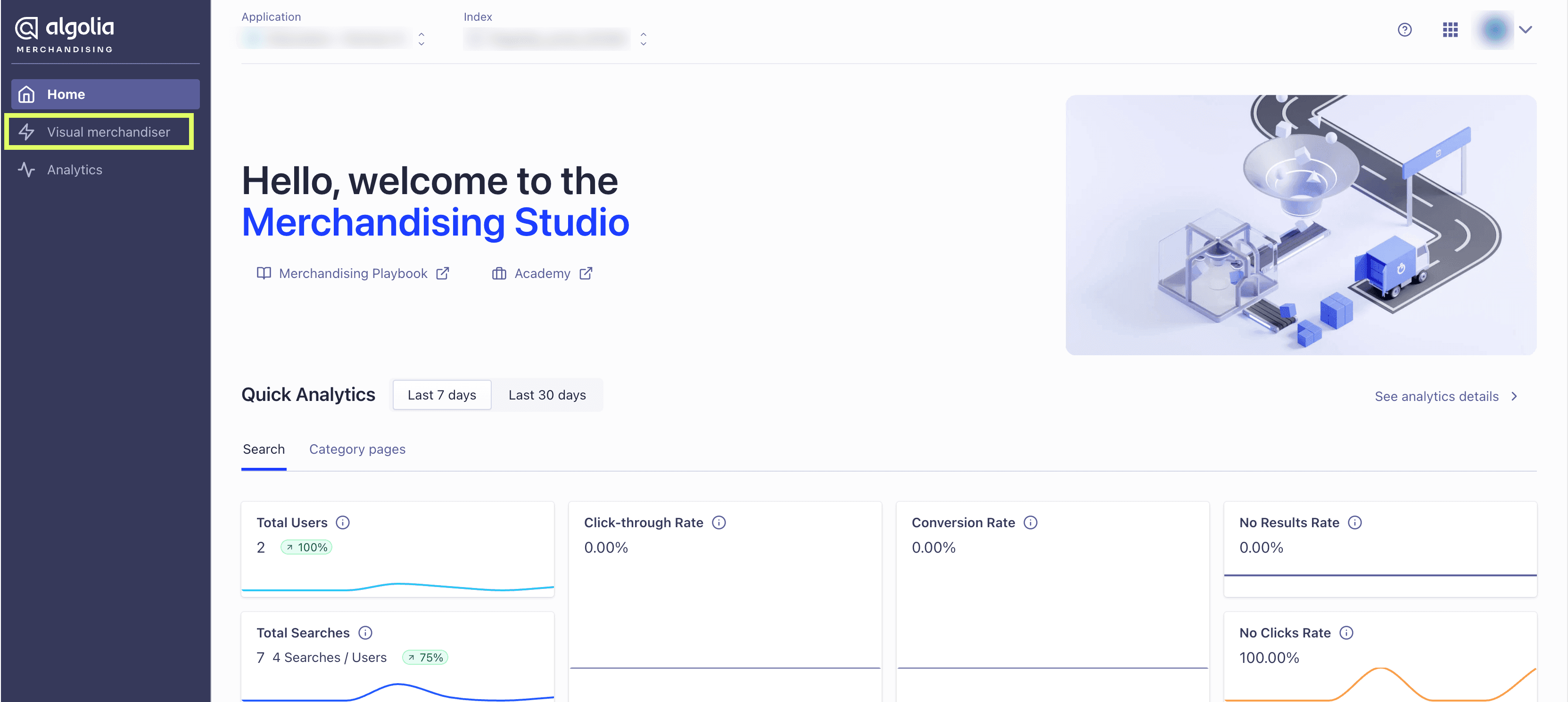 Algolia provides search services as a separate infrastructure layer. It makes all available products and variants searchable records. The developers can work with ranking, synonyms, query rules, and other functionality through APIs. This is very important for a large number of items.
Take, for example, a Shopify store where:
- There are 25000 products
- There are 75000 items
- There are 200000 search requests per month
- There are many characteristics of each product
- There are different B2C and B2B search requirements
 A development team would like to have various ranking criteria like textual relevance, popularity ranking, stock information, sales data, and others. The use of search requires too much engineering effort. Implementation requires building an indexing system and conducting API integration, applying ranking methods, and doing optimization.
The Algolia price depends on the usage of the platform.
ExpertRec: A Dedicated Search Layer for Shopify

ExpertRec has adopted a more eCommerce-oriented approach.
Rather than depending entirely on Shopify’s default search or asking companies to construct a whole search mechanism with the help of APIs, ExpertRec employs a separate search and discovery layer on top of a product catalog.
The search features encompass AI-based searching, auto-suggest, error tolerance, synonym finder, filtering, SKU searching, and search analytics.
This becomes especially helpful for catalogs in which customers habitually search with:
- SKUs
- Article numbers
- Abbreviations
- Spelled wrongly words
- Technical terms
- Natural search inquiries
- Product attributes
 For instance, an electronics store has a product:
“12V DC power supply – 5A SMPS adapter”
whereas a customer is searching for the product using the phrase:
“12v 5 amp adapter”
The search layer is responsible for linking the customer’s language with the product information.
Synonym detection, misspelling correction, search processing, attribute filtering, and relevance ranking are important features of such a search layer.
AI-powered search for Shopify stores
Make your Shopify catalog easier to search
Improve product discovery with AI-powered search, autocomplete, typo tolerance, synonyms, SKU retrieval, filtering, and search analytics with ExpertRec.
AI search • Autocomplete • SKU search • Search analytics
The Technical Difference: Retrieval and Ranking
The main distinction between these three methods is not found in the search bar, but rather in what happens after a query has been submitted.
The modern e-commerce search pipeline can be illustrated as:
Take into account the phrase:
“wireless headphones under Rs. 3,000”
A search engine should be able to recognize:
- Category, which is headphones
- Attributes, which is wireless
- Price limit — maximum of Rs. 3,000
- Synonyms used: Bluetooth/headsets
- Availability = in stock
- Ordering, which means relevance along with business signals
Shopify has built-in search and filtering functions, whereas Algolia has high flexibility in the management of the search systems. ExpertRec has a focus on providing those formidable features to clients without building a complete search engine system themselves.
Why SKU Search Matters
SKU search is of great significance in B2B, electronics, industrial, automotive, and spare parts e-commerce.
A potential buyer can input any SKU like “FV-304-25” instead of entering a long product description.
Shopify helps use SKUs and barcodes as searchable fields via its Storefront API. (Shopify)
A search engine specifically designed for SKU evaluation offers more control over the search of product name, variations, synonyms, and rankings.
When there are 50,000 or more SKUs in the catalog, the process of finding the necessary item becomes very efficient.
Search Analytics: From Queries to Revenue
Search analytics should do much more than answer the question, “How many searches were done?”
Merchants should think of:
- Which requests lead to buys.
- Which searches yield no results.
- Which requests fetch results but no clicks.
- Which products have many searched views but few clicks.
- Which words must have their synonyms.
- Which searches lead to abandonment.
- Which products should be promoted for a certain search query.
Shopify already provides reports on search efficiency (clicks, buys, and no result searches). (Shopify)
ExpertRec adds to that optimization the opportunity to carry out search analytics and experiments. (ExpertRec)
The main idea is the search optimization cycle:
INR Revenue Example
Let us assume a sample Shopify store that has:
- 10,000 sessions per month via search
- 4% conversion rate via search
- ₹2,500 average value per order
The revenue will be:
10,000 × 4% = 400 orders
400 × ₹2,500 = ₹10,00,000
In case the search improvement leads to a conversion rate increase from 4% to 4.5%:
10,000 × 4.5% = 450 orders
450 × ₹2,500 = ₹11,25,000
The monthly revenue difference will be ₹1,25,000.
This is not guaranteed growth, but it emphasizes the idea that businesses must assess their performance by using their sessions, conversion rates, average order values, and revenues from search.
Which Search Architecture Fits Your Store?
If you need only basic-level control of search and merchandising, then native search, filtering, predictive search, and merchandising attributes will suffice.
For advanced companies looking for an API-first architecture, Algolia needs to be considered so that they can depend on an architecture that requires a continuous framework of custom search capabilities.
ExpertRec is ideal for Shopify merchants who want to integrate AI technology with search features such as autocomplete, typo tolerance, synonyms, SKU retrieval, filtering, and analytics without starting from scratch.
Ultimately, the search architecture you choose depends on your product catalog’s complexity, site traffic, available search-technology staff, and your need for access and control.
Shopify offers full-fledged commerce services and a functional search foundation, while Algolia provides a fully customizable search service.
ExpertRec offers a specialized service focused on search technology in eCommerce.


