

Table of Contents
- What Is Algolia?
- Where Does Algolia Stand Out?
- Algolia Pricing in 2026
- A Practical Cost Example
- What Are the Main Limitations of Algolia?
- Algolia vs Expertrec: Which Fits Your Website?
- When Should You Consider Expertrec?
- Picking the Appropriate Alternative Search Engine from Algolia
- Final Verdict: Is Algolia Worth It in 2026?
- Frequently Asked Questions
Search is the fastest way to transform a visitor into a buyer, but the question is whether your website provides customers with the high-quality results they are looking for when they search for a product name, SKU, or misspell some word.
Algolia is a web-based technology used for search and discovery purposes. This service allows companies to benefit from API and other features such as autocomplete, customizable ranking methods, analytics, merchandising, and AI-based search capabilities.
The following Algolia Review 2026 is aimed at introducing key pros of using the mentioned platform and informing companies about the alternatives such as Expertrec that they may be interested in.
What Is Algolia?
Algolia, the search-as-a-service platform, allows programmers to include the search capabilities in websites and applications without having the cumbersome task of managing the entire search infrastructure.
Companies can index such things as catalogs, articles, documentation and other structured data and later retrieve it via search APIs.
According to Algolia, the company works with more than 18,000 clients spread across more than 150 nations. Source: Algolia.
Where Does Algolia Stand Out?
Search Relevance Exceeding Simple Matches
Algolia features typo tolerance, query suggestions, ranking options, and other features that help people obtain relevant search results even if their request is not made perfectly.
For instance, someone who issues a search for “wireless hedphones” may still find wireless headphones.
Relevance is influenced by additional factors with regard to technical teams, such as searchable attributes, ranking setups, synonyms, and quality of index records.
2. AI-Powered Retrieval
 Algolia uses AI for its neural search and ranking services, depending on your subscription plan.
NeuralSearch offers a combination of keyword search and semantic search to determine what the user means, not just the words they used. The AI ranking system looks at the user behavior and other relevancy factors to change the search result order.
Whether these two features would help in case of some ambiguous queries needs to be tested using searches on your website.
Merchandising Without Constant Code Changes
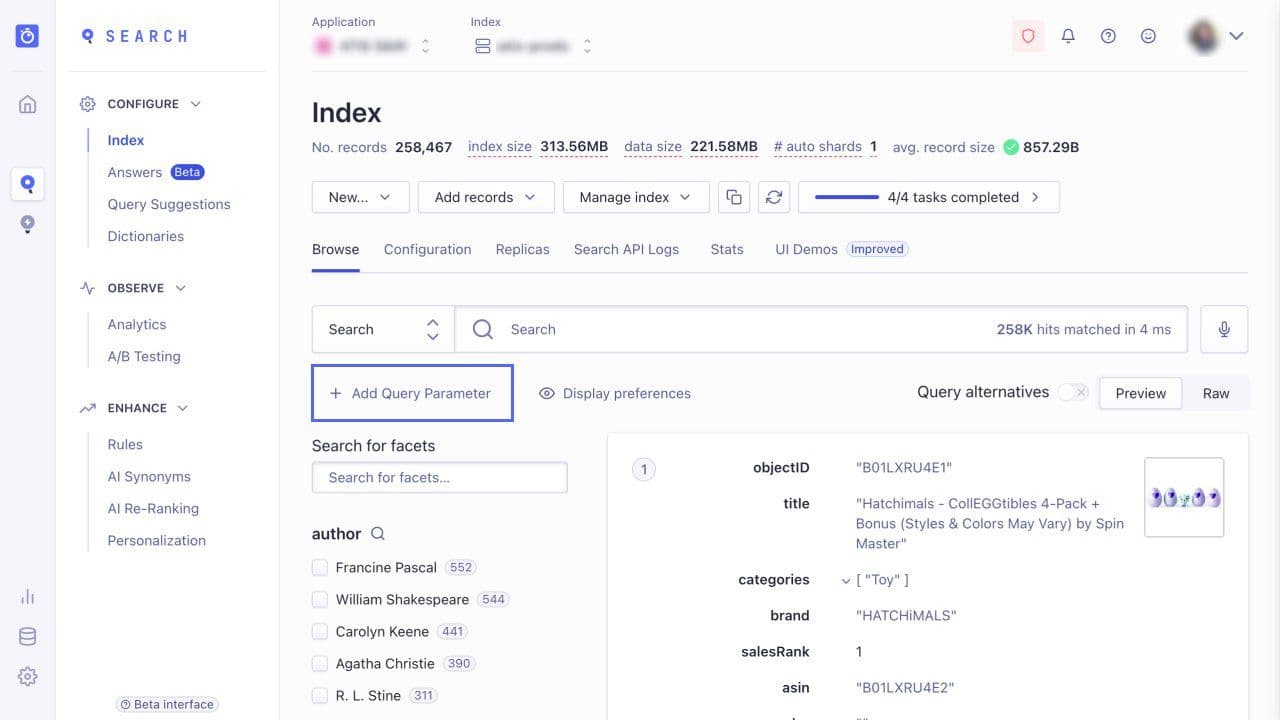 Algolia’s Merchandising Studio helps teams in a business to determine results of search, promote products, and implement merchandising strategies. When there are seasonal campaigns running, this can help a retailer to promote a new collection of products during customer searches for the main product category.
Source: Algolia’s official merchandising documentation.
Analytics for Search Optimization
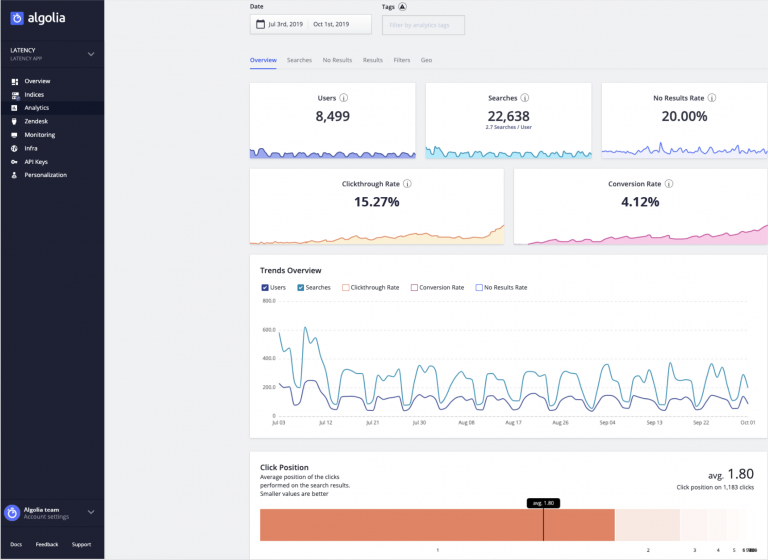
With the help of search analytics, teams can examine popular search queries, searches without results, click rates, and other important signals of search engagement.
For example, if customers enter a search term like a particular model number repeatedly but rarely click on the search results, it may mean that there are missing SKU fields, poor ranking, or incorrect matches. Analytics allow teams to find out where to look instead of relying on assumptions.
APIs and Developer Integrations
Algolia provides a variety of APIs, libraries, UI tools, and integrations to help developers create search functionalities in applications.
Such flexibility works great for teams looking to have control over the search experience. However, the amount of development required depends on the current tech stack, catalog structure, front-end needs, and an approach to integration.
Algolia Pricing in 2026
Algolia is applying a pricing strategy which is based on the usage of services from the self-service rates created. The expenses depend on such factors as the number of search queries, amount of indexed data, and functions used.
| Plan | Published pricing | Notable features |
|---|---|---|
| Free | There is no cost | 10,000 searches per month and 50,000 records |
| Grow | Customers pay $0.5 per every additional 1000 queries over 10,000 queries provided by the plan | Normal search, suggestions, creation of synonyms, and stats |
| Grow Plus | Customers pay additional $1.75 per every 1000 queries after the limit of 10,000 queries | AI synonyms, AI ranking, Personalization |
| Elevate | There is no fixed price | Corporate features of the service |
Both Grow and Grow Plus plans provide for 100,000 records.
Additional records will cost $0.4 for every 1000 records. Different services and usage can also influence the total price. Check the official Algolia pricing page before purchasing, as rates and plan inclusions can change.
Check Algolia’s official pricing page.
A Practical Cost Example
Let’s consider a hypothetical situation where an online business gets 500,000 monthly search queries through Grow.
Therefore, the initial 10,000 requests will be free of any kind of charge.
As a result, an online business will have to bear the burden of 490,000 extra queries at $0.50 per 1,000.
Considering all the additional fees, the total cost will be $245 for all queries except those related to records.
Remember to include auto-complete functionality, growth traffic, and additional features in your budgeting.
AN ALTERNATIVE TO EVALUATE
Explore smarter site search with Expertrec
Compare Expertrec with Algolia for your website’s search requirements. Explore autocomplete, typo-tolerant search, product filtering, and relevance controls based on your plan and setup.
Compare features • Evaluate setup • Review pricing
What Are the Main Limitations of Algolia?
While Algolia has many features, the suitability of these functions varies by business.
- Monitoring usage: Costs can increase depending on request volume and amount of data indexed.
- Effort to set up: Customization through an API may require developers to prepare indexing and the interfaces.
- Complex configuration: Advanced ranking and AI features may require testing and continuing optimization.
- Features differ depending on plan: Some features may only be available for certain subscriptions.
This does not mean that Algolia is not a good choice. It means that the company should consider the total costs of ownership and required maintenance.
Algolia vs Expertrec: Which Fits Your Website?
If you are looking to enhance your website’s search capabilities and product discovery without having to create everything from the ground up, it is only sensible to try out Expertrec.
| Evaluation area | Algolia | Expertrec |
|---|---|---|
| Core approach | Hosted search APIs and developer tools | Website and ecommerce search solution |
| Search capabilities | Keyword search, autocomplete, AI-enhanced retrieval, ranking | Site search, autocomplete, spelling correction, and semantic search capabilities |
| Ecommerce discovery | Search ranking, filtering, and merchandising tools | Product search, filtering, and relevance controls |
| Customization | Extensive API and UI customization | Depends on supported integrations and configuration |
| Pricing evaluation | Usage-based self-service plans and custom enterprise options | Review current plans, usage limits, and included features directly |
| Best fit to investigate | Teams needing flexible search infrastructure and advanced controls | Businesses prioritizing integrated website and ecommerce search workflows |
To see the features of Expertrec, check out the official website. The features offered by Expertrec depend on the plans and implementation. It’s crucial to verify the present functions offered by both parties before reaching a conclusion.
When Should You Consider Expertrec?
Expertrec is worth considering if you run an online store and need to have searchable product characteristics, filtering, autocomplete, or some ranking features. For instance, a clothing merchant has to allow customers to search for specific items using keywords such as product name and SKU and narrow down results by characteristics such as size, color, or brand.
Before making a decision, make sure that each of these characteristics is indexed properly and the filtering system offers the expected results on your actual catalog.
Picking the Appropriate Alternative Search Engine from Algolia
Assess these 4 important factors before switching from Algolia:
- Search accuracy: Verify the system works for exact matches, misspellings, synonyms, SKUs, long-tail searches.
- Catalogue quality: Make sure you can index all relevant fields and apply any filters required.
- Operational overhead: Find out how much time developers will need in order to deploy, maintain, and fine-tune the system.
- Overall costs: Compare maintenance costs, subscription fees, and any additional costs involved.
Other alternatives like Expertrec, Typesense and Meilisearch can involve less complexity depending on your needs. The most appropriate solution is the one which will cover your search needs and will not burden you with excess mechanisms.
Final Verdict: Is Algolia Worth It in 2026?
Businesses looking for hosted search and powerful features like extensive APIs, advanced ranking, analytic capabilities, and artificial intelligence tools are well-suited for Algolia. Additionally, it has a usage-based model that makes it suitable for any business that wants to begin with a free version and later on scale to meet its needs.
The critical question is whether Algolia’s features, pricing, and implementation requirements are in line with that of your business.
If you’re part of ecommerce teams searching for a replacement, Expertrec should be investigated alongside Algolia using actual product data and typical customer queries.
Ready to assess your options? Make sure to check Expertrec’s website “site search” solution and see how it compares with your needs.
Frequently Asked Questions
Does Algolia have a free version?
Yes. You can use Algolia for free, and the limits are 10,000 monthly requests and 50,000 records according to their current plan.
Is AI search available in Algolia?
Yes! Algolia provides AI search features including NeuralSearch and AI Ranking according to the plan.
Is Algolia beneficial for ecommerce?
Yes! Algolia comes with advanced features for product discovery, filtering, ranking, merchandising, and search analytics.
What could be the alternatives for Algolia?
You can check Expertrec, Typesense, and Meilisearch per your requirements for ecommerce integration, developer control, or self-hosting.
How to make a comparison of Algolia and Expertrec?
Try both on the same catalog, with the same queries, filters, and criteria for performance measurement. After that, check the effectiveness of both searches, integration, the number of available features, and their cost to come up with a decision.


